
Index Sec. 2 Italiano

FLIGHT MANUAL

Doc. No. 92/61 - Edition No. 3: May 25, 2010
Revision No. 5: July 12, 2022
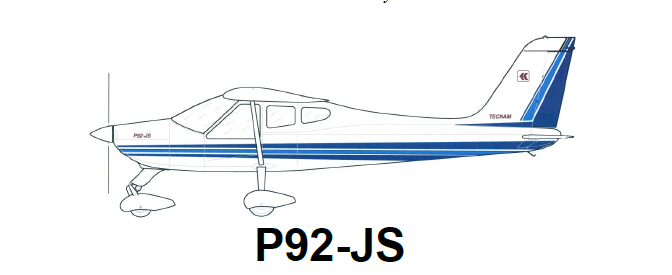
P92-JS Aircraft

P92-JS

MANUFACTURER: COSTRUZIONI AERONAUTICHE TECNAM S.r.l.

AIRCRAFT MODEL: P92-JS

TYPE CERTIFICATE: No. EASA A.412 (SO/A-340)


SERIAL NUMBER: ...............................

YEAR OF MANUFACTURE: ...............................

REGISTRATION MARKS: ...............................

This manual contains information to be provided to the pilot as required by EASA, in addition to further information provided by the manufacturer.

This manual must always be carried on board the aircraft.

The aircraft must be operated in accordance with the information and limitations contained in this document.

Revision Log

Any revision to this Manual, except actual weighing data, shall be recorded in the following table and, in the case of Approved Sections, countersigned by the competent airworthiness authority.

New or amended text in revised pages will be indicated by a black vertical line in the left margin; the revision number and date will be shown on the left side of the page.

Rev. No. Sections Affected Pages Affected Date EASA/DOA Approval
1610 to 1425/02/2015DOA
714, 1625/02/2015DOA
922, 2425/02/2015DOA
925 to 2825/02/2015DOA
21616/06/2015DOA
24, 5, 7, 1116/06/2015EASA
48, 916/06/2015EASA
712, 14, 1616/06/2015DOA
929 to 3216/06/2015DOA
30All09/09/2016DOA
610 to 1309/09/2016DOA
40All15/07/2019DOA
611 to 1315/07/2019DOA
501, 2, 4, 612/07/2022DOA
2312/07/2022DOA
45, 912/07/2022DOA
51312/07/2022DOA
71812/07/2022DOA

List of Effective Pages

Section Revision
Section 0Rev 5
Section 1Rev 2
Section 2Rev 5
Section 3Rev 0
Section 4Rev 5
Section 5Rev 5
Section 6Rev 4
Section 7Rev 5
Section 8Rev 0
Section 9Rev 2

General Index

Contents Section
GeneralSection 1
LimitationsSection 2*
Emergency ProceduresSection 3*
Normal ProceduresSection 4*
PerformanceSection 5**
Weight and Balance / Equipment ListSection 6
Aircraft and Systems DescriptionSection 7
Handling, Servicing and MaintenanceSection 8
SupplementsSection 9*

* Section approved by EASA

** Section partially approved by EASA

Sections 2, 3, 4, 5 are approved by EASA: No. 10030344 dated 11.06.2010

Section 9 (suppl. 1) is approved by EASA: No. 2004-1787 dated 02.03.2004

Section 9 (suppl. 2) is approved by EASA: No. 2004-6324 dated 17.06.2004

SECTION 1 - GENERAL

Introduction

The P92-JS is a two-seat single-engine aircraft with strut-braced high rectangular wing, fixed main landing gear and steerable nose wheel.

This Flight Manual has been prepared to provide pilots and instructors with the information necessary for safe and efficient operation of this aircraft.

This Flight Manual contains 9 sections. Section 1 provides basic data and information of general interest. It also contains definitions and explanations of symbols, abbreviations and terminology commonly used.

Certification Basis

Aircraft

This aircraft type has been approved by EASA/ENAC in accordance with JAR-VLA dated April 26, 1990 with amendments 91/1 and 92/1.

Noise Certification Basis

JAR-36 Sub. C Edition: May 23, 1997 - ICAO/Annex 16 Chap. 10 edition 1993

Warnings - Cautions - Notes

The following definitions apply to warnings, cautions and notes used in the Flight Manual.

WARNING Indicates that failure to observe the corresponding procedure results in an immediate or significant degradation of flight safety.
CAUTION Indicates that failure to observe the corresponding procedure results in a minor or more or less long-term degradation of flight safety.
NOTE Draws attention to any special item not directly related to safety but which is important or unusual.

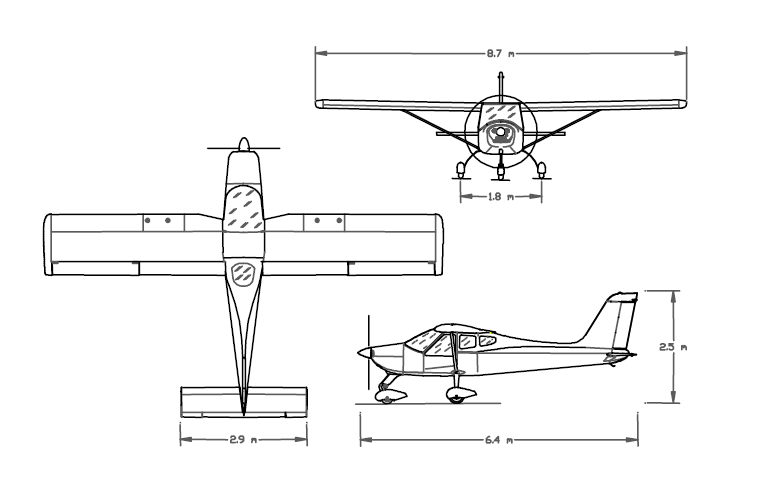
Three-View Drawing

P92-JS Three-View Drawing

Main dimensions:

  • Wing span: 8.7 m
  • Fuselage width: 1.8 m
  • Height: 2.5 m
  • Length: 6.4 m
  • Stabilator span: 2.9 m
NOTE

Descriptive Data

WING

Parameter MTOW 550 kg MTOW 600 kg
Wing span8.7 m8.7 m
Wing chord1.4 m1.4 m
Wing area12 m212 m2
Wing loading45.8 kg/m250.0 kg/m2
Aspect ratio6.316.31
Taper ratio1.01.0
Dihedral1.5deg1.5deg

FUSELAGE

Parameter MTOW 550 kg MTOW 600 kg
Overall length6.400 m6.400 m
Overall width1.100 m1.100 m
Overall height2.500 m2.500 m

EMPENNAGE

Parameter MTOW 550 kg MTOW 600 kg
Stabilator span2.900 m2.900 m
Vertical fin span1.230 m1.230 m

LANDING GEAR

Parameter MTOW 550 kg MTOW 600 kg
Track1.800 m1.800 m
Wheelbase1.600 m1.600 m
Main gear tiresAir Trac 5.00-5
Cleveland wheel and brake kit199-102
Nose wheel tireSava 4.00-6

Control Surface Deflections

Surface Deflection Tolerance
AileronsUp 20deg / Down 15deg+/- 2deg
StabilatorUp 18deg / Down 3deg+/- 1deg
Trim tab2deg ; 12deg+/- 1deg
RudderRight 25deg / Left 25deg+/- 1deg
Flaps0deg - 38deg+/- 1deg

Engine

ManufacturerBombardier-Rotax GmbH
Model912 S2
Certification basisFAR 33 Amendment 15
Austrian type certificateNo. TW 9-ACG dated Nov. 27, 1998
Type4 horizontally opposed cylinders with total displacement of 1352 cc, mixed cooling (liquid cooled heads and air cooled cylinders), dual carburetors, integrated reduction gear with torsional damper.
Maximum power73.5 kW (98.6 hp) @ 5800 rpm (max. 5 min.)
Continuous power69.0 kW (92.5 hp) @ 5500 rpm (continuous)

Propeller

ManufacturerHOFFMANN Propeller
Certification basisCAR Part 14
Type certificateSO/E 30 dated 10/12/1999
ModelHO17GHM A 174 177C
Number of blades2
Diameter1740 mm (no reduction allowed)
TypeFixed pitch - wood

Fuel

Fuel type
  • EN 228 Premium
  • EN 228 Premium plus
  • AVGAS 100LL (see Section 2.9)
Fuel tanks2 wing tanks integral with wing leading edge with fuel filter located in engine cowling.
Capacity of each wing tank35 liters (optional 45 liters)
Total capacity70 liters (optional 90 liters)
Total usable fuel66.8 liters (86.8 liters with option)

Oil System

System typePressure circulation, with external oil tank
OilAutomotive oil type API "SF" or "SG", preferably synthetic or semi-synthetic
Oil capacity3.0 liters

Cooling

System typeMixed air and liquid, pressurized closed circuit
CoolantAntifreeze and water mixture
Capacity3 liters

Maximum Certified Weights

Parameter 550 kg Version 600 kg Version
Maximum takeoff weight (MTOW)550 kg600 kg
Maximum landing weight550 kg600 kg
Maximum baggage weight20 kg20 kg

Standard Weights

Parameter 550 kg Version 600 kg Version
Standard empty weight325 kg325 kg
Maximum useful load225 kg275 kg

Specific Loads

Parameter 550 kg Version 600 kg Version
Wing loading45.8 kg/m250 kg/m2
Power loading5.6 kg/hp6.1 kg/hp

Abbreviations and Terminology

Airspeed Terminology and Symbols

KCAS
Knots Calibrated Airspeed - The indicated airspeed corrected for position and instrument errors, expressed in knots.
KIAS
Knots Indicated Airspeed - The speed shown on the airspeed indicator, expressed in knots.
KTAS
Knots True Airspeed - The speed relative to undisturbed air, obtained by correcting KCAS for altitude and temperature, expressed in knots.
VFE
Maximum Flap Extended Speed - The maximum speed permitted with flaps in a prescribed extended position.
VNO
Maximum Structural Cruising Speed - The speed that should not be exceeded except in smooth air, and then only with caution.
VNE
Never Exceed Speed - The speed limit that must never be exceeded under any circumstances.
VS
Stall Speed
VS0
Stall Speed in Landing Configuration
VS1
Stall Speed in Clean Configuration (flaps 0deg)
VX
Best Angle of Climb Speed - The speed that produces maximum altitude gain for a given horizontal distance.
VY
Best Rate of Climb Speed - The speed that produces maximum altitude gain in a given time.
Vr
Rotation Speed - The speed at which the aircraft rotates about the pitch axis during takeoff.
VLO
Lift-off Speed - The speed at which the aircraft typically lifts off the ground.
Vobs
Obstacle Clearance Speed - The speed at which the aircraft clears a 15 m obstacle during takeoff or landing.

Meteorological Terminology

OAT
Outside Air Temperature - The free air static temperature expressed in degrees Celsius (degC).
TS
Standard Temperature - Is 15degC at sea level and decreases by 2degC per 1000 ft of altitude.
HP
Pressure Altitude - The altitude read on an altimeter when the barometric scale is set to 1013 mb.

Engine Power Terminology

RPM
Revolutions Per Minute - The number of propeller revolutions per minute; multiplied by 2.4286 gives engine rpm.

Performance and Flight Planning Terminology

Crosswind Speed
The crosswind component for which adequate control of the aircraft during takeoff and landing is guaranteed.
Usable Fuel
The fuel available for flight planning.
Unusable Fuel
The quantity of fuel that cannot be safely used during flight.
g
The acceleration of gravity.
TOR
Take-Off Run - The takeoff ground roll distance measured from the actual start to the point of wheel lift-off.
TOD
Take-Off Distance - The total takeoff distance measured from start to clearance of a 15 m obstacle.
GR
Ground Roll - The distance measured during landing from actual touchdown to the point of stop.
LD
Landing Distance - The distance measured during landing from clearance of a 15 m obstacle to actual stop.
S/R
Specific Range - The distance (in nautical miles) that can be expected at a specific power setting and/or flight configuration per kg of fuel consumed.

Weight and Balance Terminology

Datum
An imaginary vertical plane from which all horizontal distances are measured for balance purposes.
Arm
The horizontal distance from the datum reference to the center of gravity (C.G.) of an item.
Moment
The product of an item's weight multiplied by its arm.
C.G. (Center of Gravity)
The point at which the aircraft, or equipment, would balance if suspended. Its distance from the datum reference is found by dividing the total moment by the total weight of the aircraft.
Standard Empty Weight
The weight of a standard aircraft, including unusable fuel, operating fluids and engine oil.
Basic Empty Weight
The standard empty weight plus the weight of optional equipment.
Useful Load
The difference between takeoff weight and basic empty weight.
Maximum Weight
The maximum certified weight of the aircraft.
Maximum Takeoff Weight (MTOW)
The maximum weight approved for the start of the takeoff run.
Maximum Landing Weight
The maximum weight approved for ground contact during landing.
Tare
The weight of chocks, blocks, stands, etc. used when weighing an aircraft, and is included in scale readings. Tare is subtracted from the scale reading to obtain the actual (net) weight of the aircraft.

Unit Conversion Table

Temperature

FromFormulaTo
Fahrenheit [degF](degF - 32) x 5/9Celsius [degC]
Celsius [degC](degC x 9/5) + 32Fahrenheit [degF]

Forces

FromMultiply byTo
Kilograms [kg]2.205Pounds [lbs]
Pounds [lbs]0.4536Kilograms [kg]

Speed

FromMultiply byTo
Meters per second [m/s]196.86Feet per minute [ft/min]
Feet per minute [ft/min]0.00508Meters per second [m/s]
Knots [kts]1.853Kilometers/hour [km/h]
Kilometers/hour [km/h]0.5396Knots [kts]

Pressure

FromMultiply byTo
Atmospheres [atm]14.7Pounds/square inch [psi]
Pounds/square inch [psi]0.068Atmospheres [atm]

Length

FromMultiply byTo
Kilometers [km]0.5396Nautical miles [nm]
Nautical miles [nm]1.853Kilometers [km]
Meters [m]3.281Feet [ft]
Feet [ft]0.3048Meters [m]
Centimeters [cm]0.3937Inches [in]
Inches [in]2.540Centimeters [cm]

Volume

FromMultiply byTo
Liters [l]0.2642US Gallons [US Gal]
US Gallons [US Gal]3.785Liters [l]

Area

FromMultiply byTo
Square meters [m2]10.76Square feet [sq ft]
Square feet [sq ft]0.0929Square meters [m2]

P92-JS FLIGHT MANUAL

Section 0: Introduction | Section 1: General

Edition 3 - Revision 5 - July 12, 2022

English version for educational purposes - Always refer to the original document
Manual Index Section 2: Limitations